
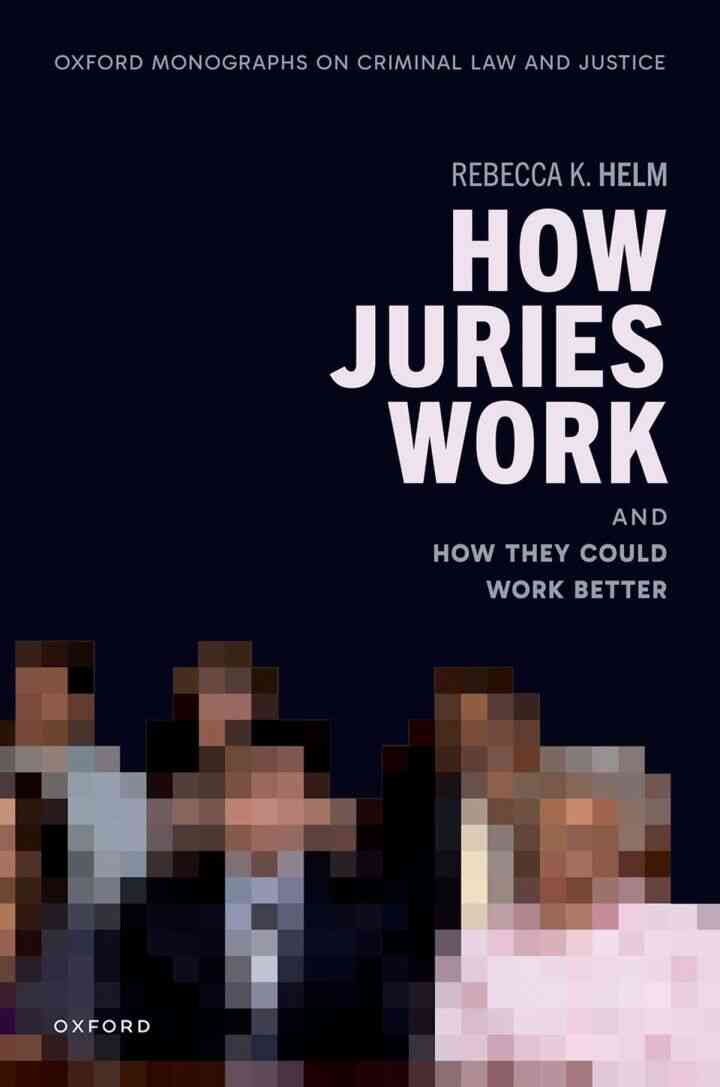
How Juries Work: And How They Could Work Better, 1st Edition eBook
$114.99 Original price was: $114.99.$44.00Current price is: $44.00.
-
Author(s): Rebecca K. Helm
-
Publisher: OUP Oxford Copyright© 2024
-
Print ISBN: 9780192857293
-
eText ISBN: 9780192671660
Delivery: Can be download immediately after purchasing. For new customer, we need process for verification from 30 mins to 12 hours.
Version: PDF/EPUB. If you need EPUB and MOBI Version, please contact us.
Compatible Devices: Can be read on any devices.
The majority of common law jurisdictions, and some civil law jurisdictions, use juries composed of citizens drawn from the general population to deliberate and reach collective verdicts in criminal cases. Juries are relied on to use their collective judgment to reach verdicts that accord with normative legal goals; for example, by being accurate and fair. How Juries Work suggests that, though important symbolically, the current jury system is not necessarily well-designed to meet the demands of modern society, which increasingly requires evidence-based procedure that is carefully designed to achieve normative goals. Rebecca K. Helm proposes new models of how jurors and juries function in practice, informed by psychological theory and empirical research, which provides a framework to interpret and integrate the large body of existing work on jury decision-making. Drawing on this framework, Helm highlights the deficiencies and strengths of the jury as a legal factfinder, providing key insights into how to minimise deficiencies and maximise strengths through trial procedure. The book concludes with a set of timely evidence-based suggestions as to how procedure surrounding trial by jury might be altered to enhance the administration of justice in the many jurisdictions where the criminal law jury is utilised. How Juries Work integrates legal and psychological theory and research to present a comprehensive assessment of the modern criminal law jury, and of how evidence-based research can improve jury performance.
This is a digital product.
How Juries Work: And How They Could Work Better 1st Edition is written by Rebecca K. Helm and published by OUP Oxford. The Digital and eTextbook ISBNs for How Juries Work are 9780192671660, 0192671669 and the print ISBNs are 9780192857293, 0192857290. Additional ISBNs for this eTextbook include 9780192671653, 9780191948107.
Reviews
There are no reviews yet.