
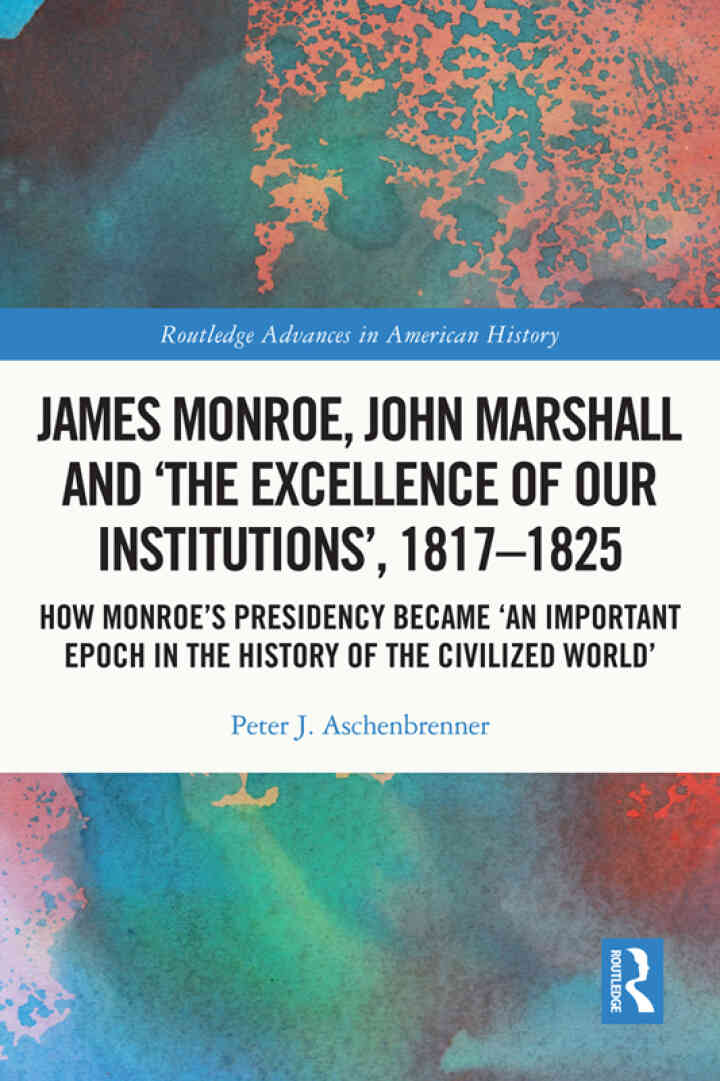
James Monroe, John Marshall and ‘The Excellence of Our Institutions’, 1817–1825: How Monroe’s Presidency Became ‘An Important Epoch in the History of the Civilized World’, 1st Edition eBook
$53.99 Original price was: $53.99.$20.00Current price is: $20.00.
-
Author(s): Peter J. Aschenbrenner
-
Publisher: Routledge Copyright© 2022
-
Print ISBN: 9781032251073
-
eText ISBN: 9781000571660
Delivery: Can be download immediately after purchasing. For new customer, we need process for verification from 30 mins to 12 hours.
Version: PDF/EPUB. If you need EPUB and MOBI Version, please contact us.
Compatible Devices: Can be read on any devices.
How Monroe’s Presidency Became ‘An Important Epoch in the History of the Civilized World’
When James Monroe became president in 1817, the United States urgently needed a national transportation system to connect new states and territories in the west with older states facing the Atlantic Ocean. In 1824, the Supreme Court declared that Congress had the power to regulate traffic on all navigable rivers and lakes in the United States. Congress began clearing obstructions from rivers, and these projects enabled steamboats to transform cross-country travel in the United States. This book explains how building a nationwide economic market was essential to secure the loyalty of geographically remote regions to the new republic. Aschenbrenner defends the activist role of President James Monroe (1817-1825) and Chief Justice John Marshall (1801-1835). Under their leadership, the federal government made national prosperity its ‘Job One’. The market revolution transformed the daily lives of households and businesses in the United States and proved to Americans that they shared a common social and economic destiny. As Monroe declared at the conclusion of his Presidency: ‘We find abundant cause to felicitate ourselves in the excellence of our institutions’.
This is a digital product.
James Monroe, John Marshall and ‘The Excellence of Our Institutions’, 1817–1825: How Monroe’s Presidency Became ‘An Important Epoch in the History of the Civilized World’ 1st Edition is written by Peter J. Aschenbrenner and published by Routledge. The Digital and eTextbook ISBNs for James Monroe, John Marshall and ‘The Excellence of Our Institutions’, 1817–1825 are 9781000571660, 1000571661 and the print ISBNs are 9781032251073, 1032251077. Additional ISBNs for this eTextbook include 9781003019381, 9780367894733, 9781000571608.
Reviews
There are no reviews yet.