
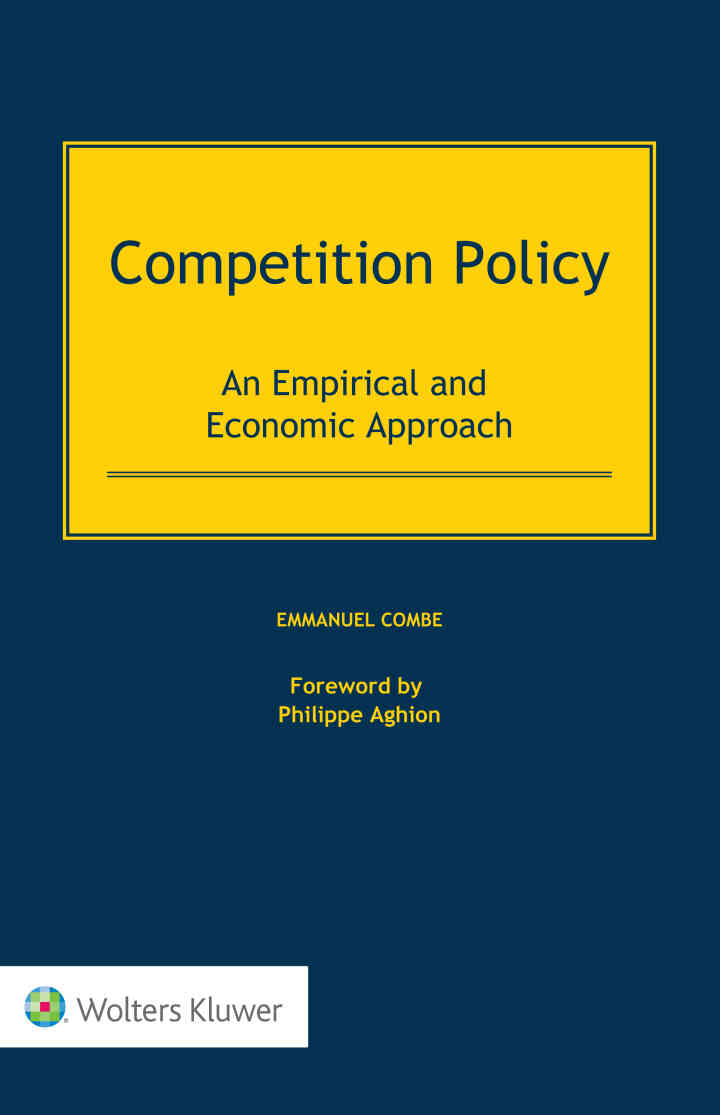
Competition Policy: An Empirical and Economic Approach eBook
$169.00 Original price was: $169.00.$62.00Current price is: $62.00.
-
Author(s): Emmanuel Combe
-
Publisher: Kluwer Law International B.V
-
Print ISBN: 9789403537313
-
eText ISBN: 9789403537511
Delivery: Can be download immediately after purchasing. For new customer, we need process for verification from 30 mins to 12 hours.
Version: PDF/EPUB. If you need EPUB and MOBI Version, please contact us.
Compatible Devices: Can be read on any devices.
An Empirical and Economic Approach
Emmanuel Combe
It is a truism of competition that, paradoxically, those who were responsible for yesterday’s innovations and productivity become obstacles to future growth. This is why competition law has been assigned such an important role in modern countries—to detect and sanction anticompetitive practices that prevent the entry of new, efficient competitors. This utterly original book, which thoroughly explains competition policy using economic analyses of European and U.S. antitrust cases, illuminates the complex but crucial back-and-forth between economic theory and competition law practice.
Covering the full range of competition policy, from antitrust (cartels, abuse of dominant position) to merger control, the book not only offers a general view of competition policy in Europe and the United States but also clearly explains the economic underpinnings that guide it, thus illustrating how principles are applied in practice. Issues and topics include the following:
economic approach of antitrust sanctions;
role of criminal sanctions and private actions;
factors favoring cartel formation and stability;
role of leniency policies;
vertical restraints in the age of e-commerce;
economic assessment of R&D and licensing agreements;
detecting and sanctioning predatory pricing;
exploitative and exclusionary abuses; and
impact of a horizontal, vertical and conglomerate mergers on competition.
All the major fields of competition policy are clearly explained, with many illustrative examples from case law. There is also a chapter presenting an overview of competition policies around the world, as well as the legal and institutional framework within which they operate.
At a time of increasing public concern regarding high industrial concentration, especially in the digital sector, the question of regulating competition is returning to the forefront. Given that the concepts and tools of economic analysis are widely used by competition authorities, this book gives lawyers a clear understanding of the objectives and instruments of competition policy. It will thus enable corporate counsel, academics, and policymakers to apply or formulate competition law with increased precision in their day-to-day work.
This is a digital product.
Competition Policy: An Empirical and Economic Approach is written by Emmanuel Combe and published by Kluwer Law International B.V. The Digital and eTextbook ISBNs for Competition Policy are 9789403537511, 9403537515 and the print ISBNs are 9789403537313, 9403537310.
Reviews
There are no reviews yet.